World-class training for the modern energy industry

Induced Seismicity in Geothermal Fields (G568)

Tutor(s)

Emmanuel Gaucher: Senior Research Geophysicist, Geothermal Energy and Reservoir Technology, Karlsruhe Institute of Technology.

Overview

This course covers fundamental and practical aspects associated with induced seismicity in deep geothermal fields. A refresher of the most relevant rock mechanics and seismological aspects will be followed by a review of the main observations and modelling approaches. Monitoring concepts for risk mitigation or reservoir imaging will also be presented.

Duration and Logistics

Classroom version: A 2-day course comprising a mix of lectures, case studies and exercises. The manual will be provided in digital format and participants will be required to bring a laptop or tablet computer to follow the lectures and exercises.

Virtual version: Four 3.5-hour interactive online sessions presented over 4 days. A digital manual will be distributed to participants before the course. This course will also contain practical exercises to reinforce key learnings. (In the virtual sessions, individual simplified questions will be asked; for a classroom version of the course, attendees will work in small groups.)

Level and Audience

Intermediate. The course is intended for geoscientists wishing to learn what seismicity in geothermal fields is, how it is induced and how we could mitigate it while using it for imaging purposes. Geoscientists from the oil and gas industry sensitive to hydrofrac operations can also join to understand differences.

Objectives

You will learn to:

  1. Assess induced seismicity characteristics to gain critical information, such as location, magnitude and fault plane solutions.
  2. Evaluate the pros and cons of the methods used to determine seismic information.
  3. Design the main features of a seismic monitoring network for specific monitoring objectives within a given geological context.
  4. Propose appropriate sensor deployment type(s), data management procedures and processing sequence.
  5. Identify the main drivers for induced seismicity in a geothermal field.
  6. Predict likely operations that could induce seismicity according to subsurface properties and structures, and identify the most critical ones.
  7. Propose appropriate mitigation approaches taking account of the subsurface characteristics and operations proposed.

Reservoir Characterization for Carbon Capture and Underground Storage, Devon and Dorset, UK (G556)

Tutor(s)

Gary Hampson: Professor of Sedimentary Geology, Imperial College London.

Matthew Jackson: Chair in Geological Fluid Dynamics, Imperial College London.

Overview

This course provides a field-based overview of reservoir characterization relevant to carbon capture and underground storage (CCS) and focuses on widely exploited reservoir depositional environments and their associated heterogeneity. The course links geological heterogeneity observed in well-exposed outcrop analogues with flow and transport processes during CO2 injection and plume migration, and also discusses the characterization and modelling of heterogeneity using typical subsurface datasets. The concepts are illustrated using numerous practical examples.

Duration and Logistics

A 5-day field course with a combination of field activities and exercises, plus classroom sessions. A manual and exercise materials will be distributed to participants on the course. Transport is by small coach.

Level and Audience

Intermediate. The course is intended for professionals with experience of, or background in, a related subsurface geoscience area, and / or recent graduates in a relevant topic.

Exertion Level

This class requires an EASY exertion level. Field locations are mainly accessed by hikes of 1–2km (roughly 1 mile) across some irregular terrain, including sandy beaches, coastal paths and pebbly / rocky beaches.

Objectives

You will learn to:

  1. Describe and explain types of geological heterogeneity associated with reservoirs, storage units and aquifers developed in common depositional environments.
  2. Evaluate how these heterogeneities can be characterized and quantified in the subsurface and represented in static and dynamic reservoir models.
  3. Consider the impact of these heterogeneities on fluid flow and transport in the context of CO2 storage.
  4. Understand reservoir characterization requirements for the prediction of CCS.

Hydrogen Masterclass: Production, Geological Storage and Operational Engineering (G552)

Tutor(s)

Katriona Edlmann: Chancellor’s Fellow in Energy, The University of Edinburgh.

Overview

Future energy scenarios foresee a prominent and growing role for hydrogen. Demand is likely to rapidly exceed the capacity of typical above-ground energy storage technologies, necessitating the need for the geological storage of hydrogen in engineered hard rock caverns, solution mined salt caverns, depleted gas fields and saline aquifers. This course will firstly provide participants with an overview of the current hydrogen landscape, including its likely role in the energy transition, production and economic challenges. The course will then focus on the need for geological storage, introducing the geological storage options available for the secure storage and withdrawal of hydrogen from these different geological stores. The main body of the course will then explore the key considerations involved in geological hydrogen storage including hydrogen flow processes and thermodynamics, geomechanical responses to rapid injection and withdrawal cycles, geochemical and microbial interactions during storage, and the operational considerations and monitoring of hydrogen storage sites that may impact storage integrity, withdrawal rates and hydrogen purity.

Duration and Logistics

Classroom version: A 3-day course comprising a mix of lectures, case studies and exercises. The manual will be provided in digital format and participants will be required to bring a laptop or tablet computer to follow the lectures and exercises. 

Virtual version: Five 4-hour interactive online sessions presented over 5 days. Digital course notes and exercise materials will be distributed to participants before the course. Some exercises may be completed by participants off-line.

Level and Audience

Intermediate. The course is largely aimed at geoscientists, but engineers will also find the course instructive. Intended for sub-surface scientists, with an emphasis on geoscience topics. Participants will probably have a working knowledge of petroleum geoscience. However, the main subject matter of this course, the geoscience of hydrogen production and storage, is covered from basic principles.

Objectives

You will learn to:

  1. Appreciate the role of geoscience in the hydrogen economy and the contribution hydrogen can make to the energy transition in support of Net Zero emission targets.
  2. Describe the different processes involved with hydrogen production and the associated lifecycle carbon intensity of this production.
  3. Recall details of the developing hydrogen supply chains, including infrastructure considerations, distribution networks and pathways for market growth.
  4. Describe the different geological storage options available and their capacity and spatial constraints.
  5. Understand hydrogen as a fluid in the subsurface, including its thermodynamic and transport properties.
  6. Characterize the geomechanical considerations for storage integrity and associated risks, including caprock sealing considerations.
  7. Appreciate the impact of geochemical and microbial interactions in subsurface hydrogen stores and the relevant monitoring and management tools.
  8. Describe the operational engineering considerations and monitoring of hydrogen storage sites.

Systems to Classify, Categorise and Report Geological CO2 Storage Capacity (G542)

Tutor(s)

Bob Harrison: Director, Sustainable Ideas Ltd.

Overview

While large scale carbon capture and storage (CCS) implementation continues to be debated, when it happens, a subsurface carbon storage management system will be needed. Such a framework must be capable of describing objective estimates of CO2 storage with respect to quantity and quality of available data, give a range of uncertainty in the estimation and provide injection project status from cradle to grave. This course reviews the subsurface carbon storage frameworks that are currently on offer worldwide.

Duration and Logistics

Classroom version: A 1.5-day course comprising a mix of lectures, case studies and exercises. The manual will be provided in digital format and participants will be required to bring a laptop or tablet computer to follow the lectures and exercises.

Virtual version: Three 3.5-hour interactive online sessions presented over 3 days. Digital course notes and exercise materials will be distributed to participants before the course.

Level and Audience

Intermediate. The course is intended for energy industry professionals, government regulatory bodies and energy sector investors.

Objectives

You will learn to:

  1. Appreciate the requirement for an auditable carbon storage reporting system.
  2. Gain familiarity with the different systems to report geologic carbon sequestration.
  3. Understand the pros and cons and limitations of the reporting systems on offer.
  4. Appreciate the key uncertainties in storage capacity estimates and how they may alter over time with increasing knowledge and experience.
  5. Be aware of bias in reporting and how to mitigate against it.
  6. Understand the need for appropriate ‘project boundaries’ to allow project comparison.

Re-purposing Oil and Gas Infrastructure for the Energy Transition (G541)

Tutor(s)

Bob Harrison: Director, Sustainable Ideas Ltd.

Overview

Attaining net zero greenhouse gas emissions by 2050 will require strategies to use existing and emerging low- or zero-carbon technologies. One potential opportunity is to repurpose existing hydrocarbon facilities to help meet net zero targets in the UK. This course investigates the technical challenges around this topic and examines whether integrating such infrastructure could lower costs and accelerate the energy transition while simultaneously postponing the decommissioning of ageing assets.

Duration and Logistics

Classroom version: A 2-day course comprising a mix of lectures, case studies and exercises. The manual will be provided in digital format and participants will be required to bring a laptop or tablet computer to follow the lectures and exercises.

Virtual version: Four 3.5-hour interactive online sessions presented over 4 days. Digital course notes and materials will be distributed before the course. The tutor will also work through a series of exercises with the group

Level and Audience

Intermediate. The course is intended for professionals working in energy transition, those involved in energy policy and energy sector investors.

Objectives

You will learn to:

  1. Understand how repurposing hydrocarbon infrastructure may aid energy transition.
  2. Appreciate how the handling of CO2, hydrogen and heat differs from oil and gas.
  3. Select sites for potential underground storage and sources of geothermal energy.
  4. Determine the suitability and availability of infrastructure for re-use.
  5. Evaluate the pros and cons of using captured CO2 for enhanced oil recovery rather than storage.
  6. Appreciate how repurposed wells and co-produced water may help potential geothermal development.
  7. Characterize risks and uncertainties in energy transition projects and discuss possible mitigation strategies.
  8. Estimate potential cost savings from hydrocarbon infrastructure re-use.

Critical Resources – Rare Earth Elements (G530)

Tutor(s)

Holly Elliott: Minerals Geoscientist, British Geological Survey.

Overview

This course covers all aspects of rare earth elements (REE) as critical resources, both in terms of technological advancement and combating climate change. We shall delve into the major sources of these elements, their tectonic settings and the enrichment processes that lead to deposit formation. The characteristics of major REE deposits shall be investigated, using international case studies, to determine typical exploration methods and factors affecting processing.

Duration and Logistics

Classroom version: A 1.5-day course comprising a mix of lectures, case studies and exercises. The manual will be provided in digital format and participants will be required to bring a laptop or tablet computer to follow the lectures and exercises.

Virtual version: Three 3.5-hour interactive online sessions presented over 3 days. A digital manual and exercise materials will be distributed to participants before the course. Some reading and exercises are to be completed by participants off-line.

Level and Audience

Intermediate. The course is intended for anyone with an intermediate knowledge of geological processes and exploration techniques.

Objectives

You will learn to:

  1. Understand the characteristics and behavior of REE in these geological environments.
  2. Understand the geological processes leading to formation of different deposit types.
  3. Understand and identify the multiple enrichment mechanisms that lead to REE-enrichment.
  4. Identify typical rocks and minerals associated with REE deposits.
  5. Evaluate typical features of REE deposits to determine appropriate exploration techniques.
  6. Interpret geochemical and exploration data associated with REE deposits.
  7. Assess the economic viability of deposits using typical characteristics.

Fractures and associated Structural Concepts for the GeoEnergy Transition: a Virtual Field Course (G511)

Tutor(s)

Richard Jones: Managing Director, Geospatial Research Ltd.

Overview

Making extensive use of virtual outcrop technologies, this course will provide participants with a field trip itinerary that includes contrasting natural fracture networks from a wide range of rock types and structural settings. The course will combine fieldwork-based appraisal of fractures with collation and processing of different types of fracture data and their practical uses in GeoEnergy Transition applications.

Duration and Logistics

Classroom version: A 3-day course comprising a mix of lectures, case studies and exercises. The manual will be provided in digital format and participants will be required to bring a laptop or tablet computer to follow the lectures and exercises.

Virtual version: Five 3.5-hour interactive online sessions presented over 5 days. A digital manual and exercise materials will be distributed to participants before the course. Some reading and exercises are to be completed by participants off-line.

Level and Audience

Intermediate. The course is intended for geoscientists looking to understand the importance of fracture systems and to learn practical methods of appraising natural fracture networks. Target participants include geologists, geoengineers and hydrogeologists, as well as oil and gas professionals looking to apply their existing expertise in new sectors.

Objectives

You will learn to:

  1. Describe the geometry and morphology of individual fractures in outcrop, and interpret the mode of fracturing.
  2. Assess relative timing of fractures, and designate fractures to different sets.
  3. Supplement outcrop data with interpretation from aerial and satellite imagery.
  4. Characterize spatial properties of the fracture network, including spacing, clustering and scaling (size-intensity) relationships.
  5. Evaluate the nature of fracturing in relation to larger scale features: folds, faults and mechanical stratigraphy.
  6. Collate fracture data to produce a conceptual fracture model.
  7. Understand the interplay between fractures and matrix, in terms of porosity and permeability, and the implications for fluid storage and flow.
  8. Predict the general performance of a fracture network in practical GeoEnergy Transition applications.
  9. Recognize the strengths and limitations of different sources of fracture data, and the advantage of combining field data with other data types.

Introduction to Low Enthalpy Geothermal Exploration (G506)

Tutor(s)

Mark Ireland: Senior Lecturer in Energy Geoscience, Newcastle University.

Overview

This course covers all aspects of low enthalpy geothermal exploration and production. It is intended as an introduction to the entire lifecycle of low enthalpy geothermal resources, covering aspects of geoscience and engineering.

Duration and Logistics

Classroom version: A 3-day course comprising a mix of lectures, case studies and exercises. The manual will be provided in digital format and participants will be required to bring a laptop or tablet computer to follow the lectures and exercises.

Virtual version: Five 3.5-hour interactive online sessions presented over 5 days. A digital manual and exercise materials will be distributed to before the course. Some reading and exercises are to be completed by participants off-line.

Level and Audience

Intermediate. The course is intended for all career stage industry professionals and early career researchers with a geoscience or geo-engineering background, including those with a familiarity in oil and gas production.

Objectives

You will learn to:

  1. Understand the applications and use of low enthalpy geothermal energy.
  2. Recall the basic principles of heat generation within the upper crust.
  3. Describe the key characteristics of geothermal resources and reservoirs.
  4. Understand the production options for low enthalpy geothermal resources.
  5. Appreciate project risks and uncertainties in developing geothermal resources.

Carbon Capture and Storage Masterclass (G502)

Tutor(s)

Richard Worden: Professor in the Department of Earth Ocean and Ecological Sciences, University of Liverpool, UK.

Overview

This course will provide participants with awareness of the geoscience needs for CCS projects; namely subsurface CO2 storage volumetrics, CO2 flow in the subsurface away from injector wells, the goal of safe and permanent storage of CO2 and cost-benefit issues linked to aquifer depth, well design, etc. The course will establish basics, such as how much CCS is needed to make a difference to global warming, and explore what types of CO2 injection are already happening, including information from CO2-enhanced oil recovery projects. The course will deal with CO2 as a fluid phase and how much CO2 can be stored per cubic meter in terms of porosity and over entire aquifers. It will deal with how quickly CO2 can be injected and the role of aquifer permeability. The course then moves on to the all-important geomechanical effects of CO2 injection and feedbacks between induced mineral dissolution and rock strength and other rock properties. The full range of possible interaction between CO2 and both aquifer and top-seal will be covered, as will the range of possible leakage mechanisms that need to be assessed. The course will conclude with consideration of monitoring strategies.

Duration and Logistics

Classroom version: A 3-day course comprising a mix of lectures, case studies and exercises. The manual will be provided in digital format and participants will be required to bring a laptop or tablet computer to follow the lectures and exercises.

Virtual version: Five 3.5-hour interactive online sessions presented over five days. Digital course notes and exercise materials will be distributed to participants before the course. Some exercises may be completed by participants off-line.

Level and Audience

Intermediate. The course is largely aimed at geoscientists, but engineers will also find the course instructive. Intended for sub-surface scientists, with an emphasis on geoscience topics. Participants will probably have a working knowledge of petroleum geoscience. However, the subject matter of this course, the geoscience of carbon capture and storage, is covered from basic principles.

Objectives

You will learn to:

  1. Develop awareness of the role of geoscience in CCS and of CCS in CO2 emissions reductions.
  2. Appreciate what CO2 injection projects have occurred so far and how they differ from industrial CCS.
  3. Understand CO2 as a fluid in the subsurface and the fluid injection pressure and effective stress regimes that CO2 injection will involve.
  4. Build awareness of the volumetrics of CO2 storage from the micro (pore-scale) to the macro (aquifer volumes).
  5. Gain an appreciation of the question of CO2 flow away from injector wells controlled by permeability and aquifer architecture.
  6. Understand the range of effects that CO2 can have on the host aquifer, from geomechanical to geochemical.
  7. Assess the role of top-seal and fault-seal properties and how they will influence CO2 storage, from risk of fracking, or induced seismicity, to mineral dissolution.
  8. Understand the range of ways that CO2 could escape from the planned storage sites.
  9. Develop an awareness of the range of monitoring strategies that could be employed to ensure safe and long-term storage of CO2.

Best Practices in Pore Pressure and Fracture Pressure Prediction (G043)

Tutor(s)

Richard Swarbrick: Manager, Swarbrick GeoPressure.

Overview

This course presents best practices in how data and standard techniques are combined to generate meaningful pore pressure (PP) and fracture pressure (FG) estimates from log, seismic and drilling data, and to use them to develop pre-drill predictions. The limitations are addressed, along with common pitfalls, leading to an understanding of the uncertainty and risk associated with PP and FG prediction.

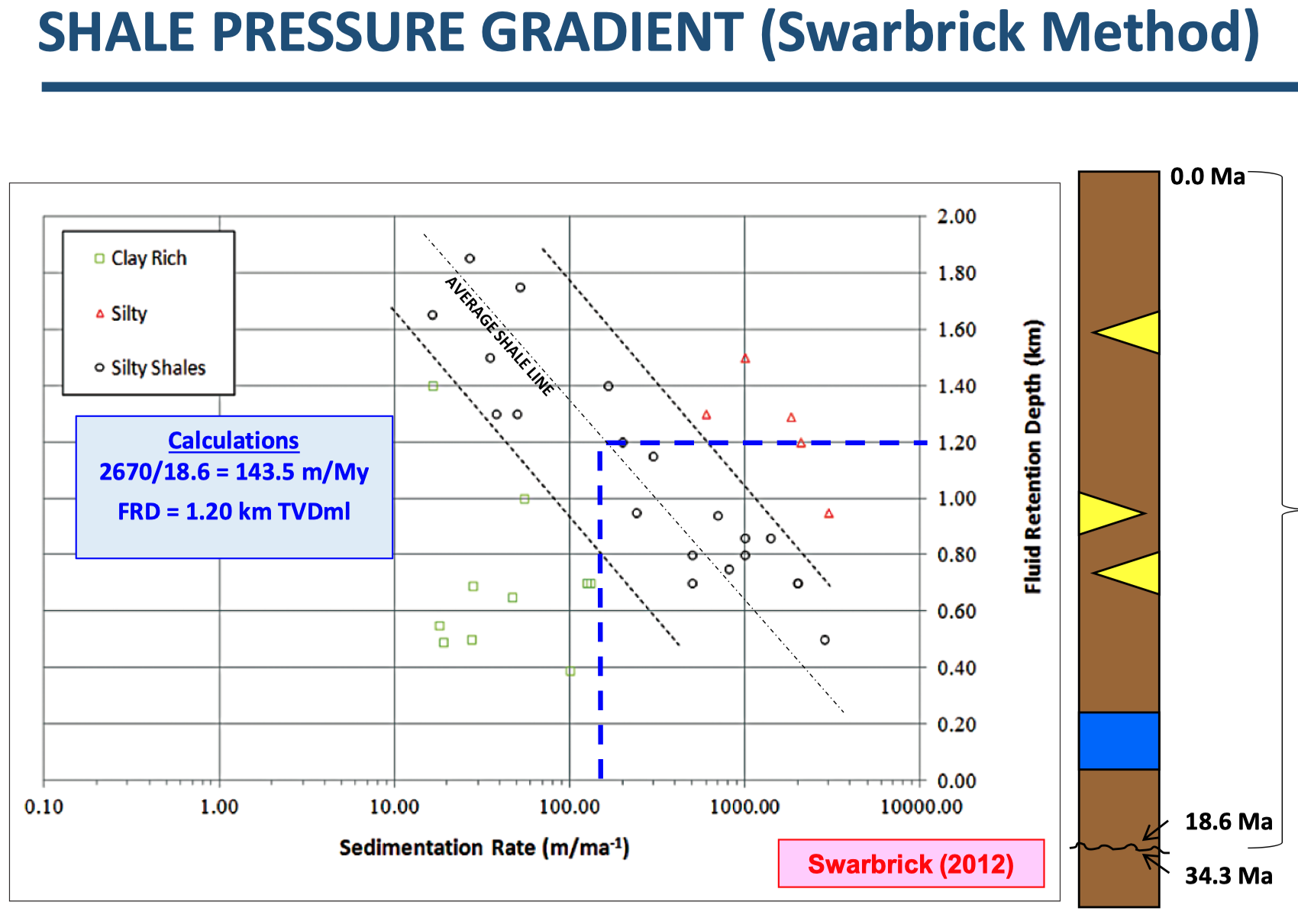
The course begins by showing the types and reliability of subsurface data used to inform current knowledge, which will also calibrate PP and FG predictions at a remote location. Standard approaches to PP and FG prediction techniques are taught, with careful attention to where these have limitations on account of subsurface environment (thermal, tectonic) and data quality. A new approach to PP prediction using shales is taught as an independent guide to expected PP, especially valuable where only seismic data are available. Prediction of FG is taught by showing how to determine overburden stress and apply standard relationships, including new approaches with PP-stress coupling.

Duration and Logistics

Classroom version: A 2-day classroom course comprising a mix of lectures and discussion (90%) and exercises (10%). The manual will be provided in digital format, and participants will be required to bring a laptop or tablet computer to follow the lectures and exercises.

Virtual version: Four 3.5-hour interactive online sessions presented over 2 to 4 days. A digital manual and exercise materials will be distributed to participants before the course. Some reading and several exercises are to be completed by participants off-line.

Level and Audience

Intermediate. Intended for exploration and development geoscientists, petrophysicists, operations staff and drilling engineers. Familiarity with oilfield data and drilling practices is required. Experience shows that mixed classes of geoscientists and engineers benefit particularly from the discussions and sharing of approaches in this multi-disciplinary area of work.

Objectives

You will learn to:

  1. Distinguish the different types and quality of data that populate pressure-depth and EMW-depth plots for display of pressure predictions and calibration data in well planning.
  2. Use best practice to create PP estimations and predictions from seismic, log and drilling data using standard porosity-based techniques, and from modelling geological systems.
  3. Use best practice to create FG estimations and predictions by generating an overburden and establishing its relationship with FG and PP.
  4. Communicate Min-Expected-Max predictions effectively to both geoscience and engineering/operations staff involved in well planning.