Tutor(s)
Brian Matthews: Independent Consultant, Founder and Managing Director of TerraUrsa
Overview
The aim of this course is to provide an overview of the economic and market opportunities of renewables in the context of European decarbonisation policies and targets.
Duration and Logistics
Classroom version: Two-day classroom workshop.
Virtual version: Option 1: One 3-hour interactive online session that would cover contents sections 1-4. Option 2: Two 3-hour interactive online sessions would include content sections 1-6.
Level and Audience
Fundamental. The one-session course is aimed at non-technical staff and those who do not have a business background but want a basic introduction to the topic. The subject matter will be covered from very basic principles and will be of interest to staff from a range of departments. The two-session course is aimed at middle and senior managers who can influence strategy within the company.
Objectives
You will learn to:
- Understand global and European energy demand trends to 2050.
- Explore the economic and market opportunities of renewables.
- Analyse primary energy supply projections and the role of different energy sources.
- Examine European decarbonisation policies and targets.
- Evaluate case studies to assess market context, policy drivers, and commercial strategies.
- Develop and assess a sustainability timeline.
Tutor(s)
Eric Gaucher: CEO, Lavoisier H2 Geoconsult and RockyH2.
Jean Gaucher: Development Officer, Lavoisier H2 Geoconsult.
Overview
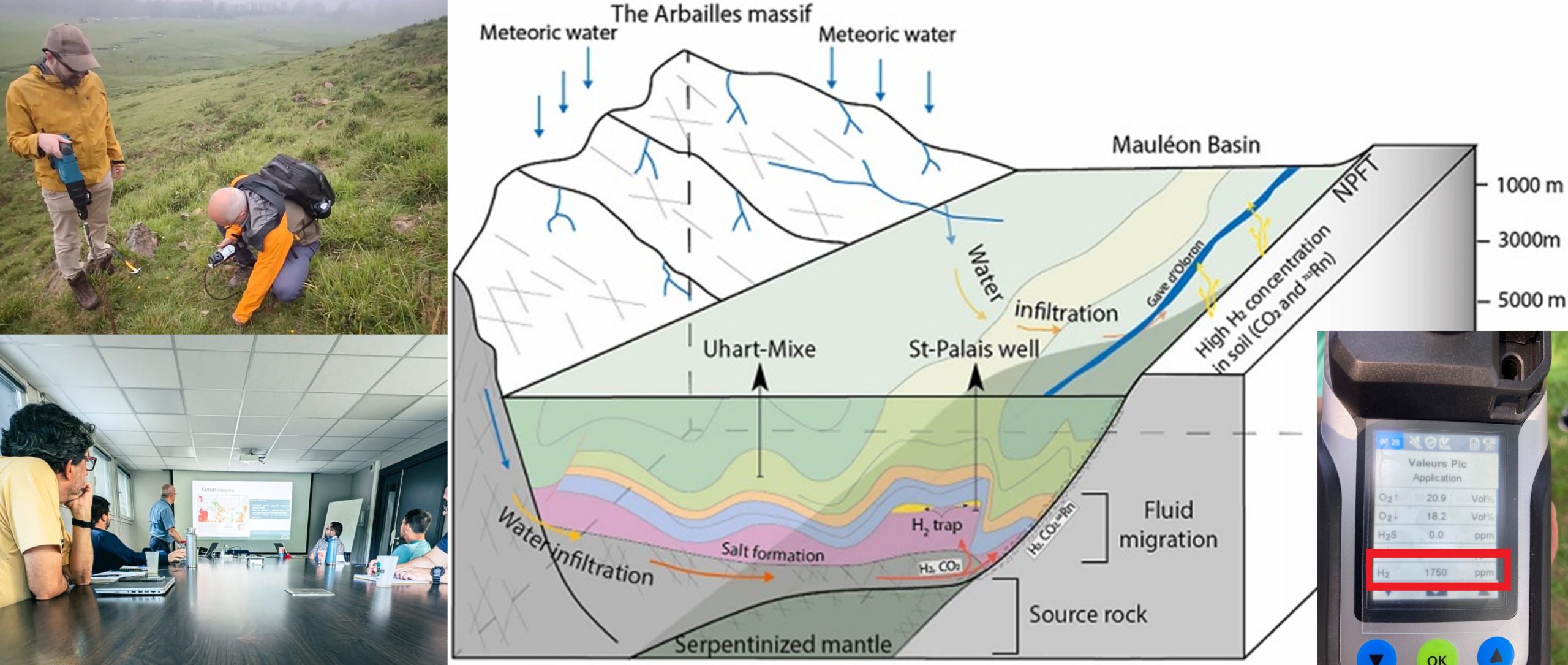
The last few years has seen a growing interest in natural hydrogen accumulations. We know that there are a variety of processes that can lead to hydrogen being produced in the Earth’s crust but there is much still to understand about these, how much is perhaps present in subsurface stores and where these accumulations are. Commercial exploitation will also need to assess the engineering challenges for extracting this hydrogen and ultimately how best it can be utilised as part of the changing face of our modern energy landscape. This course will give an integrated view on the economic, strategic and scientific aspects of natural hydrogen exploration and its perspectives.
Duration and Logistics
Virtual version: Four 3.5-hour online sessions presented over four days comprising a mix of lectures, exercises, case studies and discussion. The course manual will be provided in digital format.
Fieldtrip version: A 5-day field course located in Pau, France with a focus on the geological aspects of natural hydrogen.
Level and Audience
Fundamental. The course is largely aimed at geologists interested in natural hydrogen occurrences but the trainers able to adapt the level of the course to the requirements of the attendees.
Exertion Level
This class requires and EASY exertion level. Travel is by small coach and there are hikes of less than 10 minutes in duration (less than 1 km) on well-graded terrain in the foothills of the Pyrenees.
Objectives
You will learn to:
- Evaluate the different types of hydrogen and the origins of natural hydrogen.
- Characterise the strategies for the exploration of natural hydrogen.
- Clarify and organize the different technical steps of a natural hydrogen exploration programme.
- Appraise the geological, geochemical and geophysical tools that can be used for natural hydrogen exploration.
- Assess the co-production of natural hydrogen with geothermal resources, Helium and the mining industry.
- Assess the techno-economic evaluation of natural hydrogen.