

Tutor(s)
Gus Gustason: Senior Geologist and Geoscience Advisor, Enerplus Resources.
Richard Bottjer: President, Coal Creek Resources; Research Associate, Denver Museum of Nature and Science.
Overview
This core-based facies analysis course will use the petroleum system of the prolific Powder River Basin to develop realistic depositional models and sequence stratigraphic frameworks that can be used to better predict the extent and continuity of unconventional resources. Demonstrations will introduce participants to core handling, description and data integration techniques. Lectures and exercises will re-familiarize participants with lithofacies and facies associations and will describe applications of core-facies analysis to reservoir characterization of siliceous and calcareous mudstones, muddy sandstones and sandstones. Cores will be from the Powder River Basin, but learnings may be applied to resource plays in other basins.
Duration and Logistics
A 5-day classroom course comprising a mix of classroom lectures (25%) and core description exercises (75%) at the USGS Core Research Center, Lakewood, CO. The manual will be provided in digital format and you will be required to bring a laptop or tablet computer to the course.
Level and Audience
Fundamental. This course is intended for entry-level through mid-career geoscientists, reservoir engineers and petrophysicists who want to extract maximum value from cores, in order to improve exploration play analysis and reservoir characterization of both conventional and unconventional resources. Participants should have a basic knowledge of clastic and carbonate sedimentology and stratigraphy.
Objectives
You will learn to:
- Identify the important physical and biological parameters of core, including sedimentary structures, biogenic structures, significant surfaces and diagenetic textures. We will examine siliceous and calcareous mudstones, muddy sandstones and sandstones.
- Calibrate core descriptions with wireline log data.
- Evaluate source rock potential of mudstones using elemental chemistry data (XRF), TOC, RockEval (Vre) and vitrinite reflectance (Vro) data.
- Integrate routine core analysis and/or unconventional shale and tight rock analysis with core descriptions to better understand the controls on porosity and permeability.
- Identify basic structural features in cores, such as faults and fractures, and relate them to mechanical stratigraphy, in situ stresses and borehole stability issues.
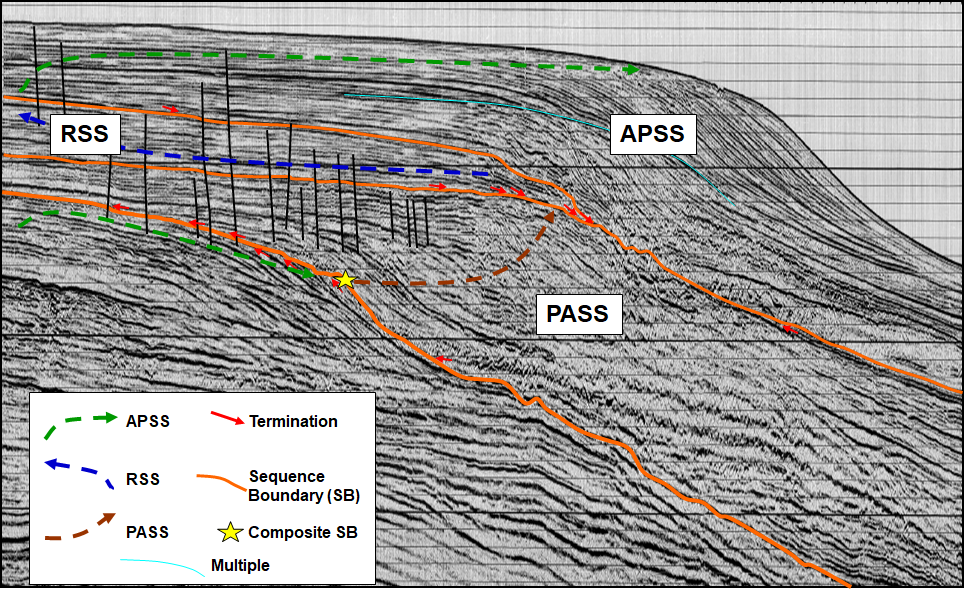
- Develop a sequence stratigraphic framework from core descriptions and wireline log data.
- Compare reservoir characteristics with production performance to identify target zones for horizontal well placement.
- Discretize core descriptions for core-to-log facies analysis and reservoir modelling input.